India Gate Delhi Vector Art
A Designer’s First Look: Clean, Cultural, and Craft-Ready
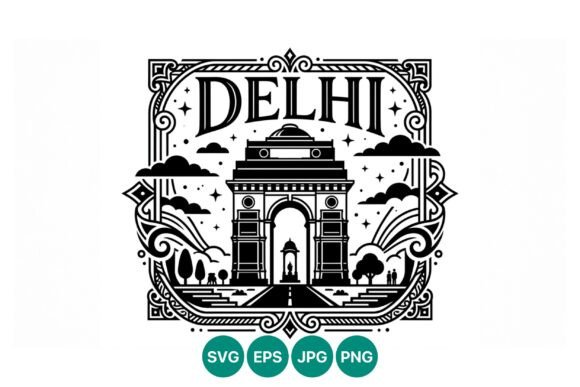
Opening the ZIP folder for India Gate Delhi Vector Art, I felt that quiet spark of recognition — not just because it’s a landmark I’ve sketched from memory dozens of times, but because the composition lands with intention. It’s black and white, uncluttered yet rich in symbolic detail: the arch stands centered, flanked by a delicate ornamental border, soft stylized clouds, scattered stars, and subtle tree silhouettes framing the edges. This isn’t a photorealistic rendering — it’s a graphic interpretation built for translation. As an embroidery designer who’s stitched everything from monogrammed baby onesies to boutique aprons for Delhi-based craft shops, I immediately saw how this illustration could move off-screen and into thread.
Where It Shines: Real Projects, Real Stitching
I tested India Gate Delhi Vector Art as the focal motif on a custom embroidered cotton tote bag — the kind sold at weekend craft fairs or gifted at cultural festivals. On natural canvas, the clean lines held beautifully in satin stitch for the arch outline and fill stitch for the inner structure. The ornamental border softened nicely at 85% density, avoiding stiffness while retaining definition. Customers responded strongly: “It feels meaningful, not generic,” one told me — exactly the emotional resonance you want in a handmade product.
It also translated well onto a lightweight organic cotton sweatshirt (using tear-away + cut-away stabilizer combo), especially when placed left-chest. The stars and clouds added gentle visual rhythm without overwhelming the garment’s drape. For nursery decor, I scaled it down for a pillow cover — the tree silhouettes and open negative space kept it breathable and calm, never busy. And yes, it works for holiday embroidery: imagine it stitched in ivory thread on charcoal linen tea towels — elegant, understated, quietly festive.
Where to Proceed Thoughtfully
This design is expressive, but its charm lies in balance — and balance requires attention. On curved surfaces like caps or structured hats, the outer ornamental border may need slight simplification or repositioning to avoid distortion near the crown seam. Tiny details — like individual star points or fine cloud contours — can blur on stretchy fabrics (think jersey baby onesies) or thin weaves unless stabilized properly. I’d avoid placing it directly over seams or high-movement zones without testing stitch tension first.
Dark fabric? Yes — but only if your thread contrast is intentional. A matte black thread on navy twill reads sophisticated; the same on charcoal fleece can vanish without careful density adjustment. Also, dense fill areas within the arch base may require reduced stitch count or strategic underlay on textured fabrics like terry cloth or bouclé — otherwise, the design risks looking muddy rather than dimensional.
What It Adds — Beyond the Stitch
India Gate Delhi Vector Art elevates perceived value without shouting. It doesn’t scream “custom” — it whispers “considered.” That matters for Etsy sellers listing personalized gifts or small shop owners building brand consistency around heritage and place. Buyers notice the care: the even spacing of stars, the graceful curve of the clouds, the way the border echoes Mughal-era motifs without literal replication. That subtlety builds trust — especially for international customers seeking authentic Indian design assets.
For commercial embroidery, it reads professionally in mockups and finished products alike. When used in printable mockups for client pitches or digital product previews, its vector clarity ensures crisp scaling across thumbnails, banners, and social posts. And unlike overly intricate illustrations, it doesn’t demand premium thread counts or multi-hooping — making it efficient for small-batch production without sacrificing character.
Practical Notes Every Embroidery Designer Should Keep Handy
- Always test on scrap fabric first — especially with your exact stabilizer stack and thread brand. What looks balanced on screen may shift under needle tension.
- Review stitch density before finalizing. High-density fill in the arch base pairs well with medium-weight cotton, but consider reducing density by 10–15% for baby embroidery or lightweight apparel.
- Confirm hoop size compatibility. The full composition fits comfortably in a 5×7 hoop, but the ornamental border may extend near the edge — verify clearance before hooping.
- Inspect small details at actual stitch scale. Zoom in on your embroidery software: do star points translate cleanly? Are cloud edges smooth or jagged when converted?
- Test in black-and-white mockups — both light and dark backgrounds. This reveals contrast issues early, especially if you plan to offer multiple thread color options.
- Use proper stabilizer for fabric type: cut-away for knits, tear-away for stable wovens, and fusible + tear-away for lightweight linens.
- Verify licensing terms before selling finished items or bundling India Gate Delhi Vector Art into digital embroidery files. Since it’s categorized under Illustrations and Graphics, confirm whether commercial use is included — many designers overlook this until a marketplace dispute arises.
Final Thought: A Design That Serves the Maker
India Gate Delhi Vector Art doesn’t try to be everything. It’s not a maximalist festival print, nor a minimalist monogram. It’s a focused, culturally grounded graphic — one that respects embroidery’s physical limits while inviting thoughtful execution. Whether you’re stitching a single personalized gift or producing 50 tote bags for a boutique launch, it supports your process instead of complicating it. That’s rare. And that’s why, after years of sifting through thousands of embroidery files, I keep this one in my go-to folder — not for its novelty, but for its quiet reliability.