Fabric Before Chores Craft Sewing Vector
As someone who’s stitched hundreds of designs across apparel, home goods, and boutique merchandise — from Etsy bestsellers to custom bridal aprons — I opened Fabric Before Chores Craft Sewing Vector expecting charm. What I got was something sharper: a confident, playful, and *very stitchable* illustration that lands exactly where it should — in the sweet spot between crafty personality and embroidery practicality.
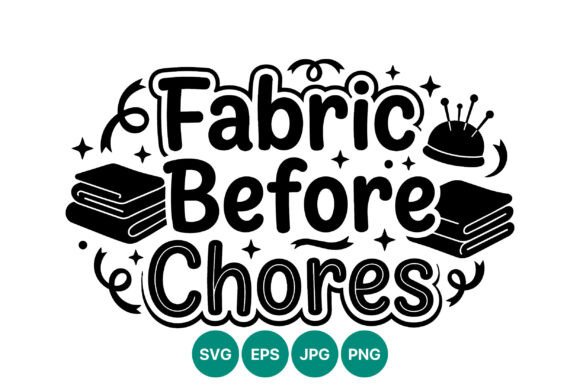
I tested it first on a linen-cotton tea towel for a small-batch kitchen gift line. The black-and-white vector art popped cleanly against the natural fabric, and the bold playful font held up beautifully at 3.5 inches wide — no letter distortion, no fragile serifs collapsing under satin stitch. The surrounding sewing pins and fabric stacks aren’t just decoration; they’re visual anchors that balance the phrase without crowding it. That matters. Too many “crafty” designs drown the message in clutter. This one breathes.
The mood is warm but intentional — not cutesy, not ironic, not overly nostalgic. It says, *I love making things, and I’m proud of it.* That tone translates directly into customer trust. When you embroider Fabric Before Chores Craft Sewing Vector onto a canvas tote for your Etsy shop, buyers don’t just see text — they recognize shared values. Same goes for personalized baby onesies or holiday kitchen towels: it feels handmade because it’s designed like something made by hand, even though it’s digital.
Where this design shines most is in medium-to-large format applications: sweatshirt chest logos, pillow covers, embroidered patches (especially iron-on or sew-on versions for craft fairs), and apron pockets. The swirls and pin motifs scale well without losing definition, and the clean vector lines convert reliably to embroidery files — assuming your digitizer respects the original spacing and weight. For machine embroidery design use, I’d recommend keeping it between 3" and 5" wide for optimal clarity on cotton twill, denim, or medium-weight quilting cotton.
That said, Fabric Before Chores Craft Sewing Vector isn’t magic on every surface. Avoid it on curved, high-stretch areas like baseball caps unless you’re using a specialty cap frame and lightweight stabilizer — those decorative swirls can distort near the crown seam. Tiny hoop sizes (<2.5") will sacrifice legibility in the smaller pin details and inner swirl curves. And while the black-and-white base gives you flexibility, be mindful on dark fabric: white thread over navy or charcoal works, but fine pin outlines may disappear without a proper underlay or slight stroke expansion in your digitizing software.
Texture is another quiet factor. On terry cloth towels or thick fleece, the design’s clean edges stay crisp — but only with cutaway or tear-away stabilizer underneath. Skip stabilizer, and the fill stitch in the “fabric stack” elements can pucker or shift. Likewise, thin or silky fabrics (like rayon challis or lightweight voile) need extra care: test stitch density first. Dense fill areas in the stacked fabric shapes could cause stiffness or shadowing if over-digitized.
For commercial embroidery projects — think wholesale aprons for local bakeries or custom tote bags for a makers’ market booth — Fabric Before Chores Craft Sewing Vector holds up as brand-consistent design assets. It’s distinct enough to stand out in a crowded Etsy listing, yet versatile enough to pair with neutral packaging or minimalist mockups. I’ve used it in printable mockups for client presentations, and it reads instantly: no squinting, no second-guessing the message. That clarity builds buyer engagement before a single stitch is made.
Here’s what I always do before committing Fabric Before Chores Craft Sewing Vector to a finished product:
- Test on scrap fabric — same type, same color, same stabilizer as the final project.
- Check thread color contrast — especially for the small pin heads and swirl endpoints.
- Review stitch density — avoid overfilling the fabric stacks; let them breathe.
- Confirm hoop size compatibility — measure the full design width including swirl extensions.
- Inspect small details — zoom in on the tip of each pin and inner curve of swirls for potential breakage points.
- Mock it in black and white — verify readability on light and dark backgrounds before digitizing.
- Use proper stabilizer — medium-weight cutaway for knits, tear-away for stable wovens.
- Verify licensing — since this is an Illustrations download, confirm whether commercial embroidery use and resale of finished products are permitted.
This isn’t just another cute phrase turned graphic. Fabric Before Chores Craft Sewing Vector works because it’s built for real hands, real machines, and real customers. It fits naturally into handmade product workflows — whether you’re stitching a single personalized gift or scaling for a craft business launch. It doesn’t shout. It invites. And in embroidery, where subtlety and structure both matter, that’s rare.
If you’re an Etsy seller choosing your next embroidery file for a spring collection, a small shop owner refreshing your boutique branding, or a hobbyist planning a thoughtful holiday embroidery project — this one earns its place in your design assets. Just remember: great vector art is only half the story. The other half is how thoughtfully you translate it into thread, fabric, and intention.